
The C-Suite Hunt: Landing Executive Roles in the US and European Markets
You've climbed the ladder. You've led teams, managed P&Ls, and delivered results. But landing your next executive role—especially if you're considering opportunities on both sides of the Atlantic—requires a fundamentally different playbook than your earlier job searches. Executive hiring is invisible. Most C-suite positions are never posted publicly. They're filled through networks, headhunters, and quiet conversations. If you're aiming for a VP, Director, or C-level role in the US or Europe, here's how the game is played at the top.
NEW JERSEY
2/20/20264 min read


The Invisible Job Market
At the executive level, the job market operates in the shadows. Estimates suggest that 70-80% of executive roles are never advertised. They're filled through:
Executive Search Firms: Retained by companies to find the perfect candidate.
Personal Networks: Former colleagues, board members, and industry peers.
Inbound Interest: Candidates who are "known quantities" through speaking engagements, articles, or industry reputation.
Your first job, therefore, is not to search job boards. It's to make yourself visible to the people who do the hiring.
The US Executive Market: Speed, Swagger, and Scale
The American executive landscape values confidence, decisiveness, and growth. US companies, particularly in tech and finance, move fast and expect their leaders to do the same.
What US Companies Look For:
Scalability: Have you grown a team from 10 to 100? A revenue line from $5M to $50M? US companies love evidence of scale.
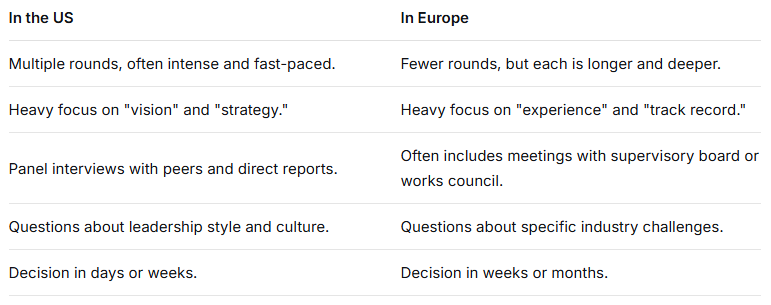
Vision: Can you articulate where the industry is going? Executive interviews often include "vision presentations" where you outline your 3-year plan.
Cultural Leadership: In the US, "culture fit" is critical. They want to know you can inspire teams, manage up, and represent the company publicly.
Risk-Taking: Americans admire bold moves. If you've taken calculated risks (even if they didn't all work out), frame them as learning experiences.
The US Executive Resume:
2 pages max (yes, even for executives).
Focus on achievements, not responsibilities. Use the "X, Y, Z" formula: "Increased revenue by X% through Y strategy, resulting in Z dollars."
Include a powerful "Executive Summary" at the top: 3-4 lines that encapsulate your brand.
List board memberships, speaking engagements, and publications.
The European Executive Market: Substance, Stability, and Structure
European executive hiring is generally more deliberate. The culture values depth of experience, industry expertise, and a proven track record within similar organizational structures.
What European Companies Look For:
Deep Domain Expertise: In Germany or France, you're expected to be a true expert in your field. Generalists are viewed with more skepticism.
International Experience: Fluency in multiple languages and experience managing cross-border teams is a significant advantage.
Stakeholder Management: European executives often navigate complex stakeholder landscapes—works councils, unions, family owners, and regulatory bodies. Experience here is gold.
Long-Term Thinking: European boards are often more cautious and value sustainable, long-term strategy over rapid, disruptive growth.
The European Executive CV:
3 pages is acceptable, sometimes expected.
Detailed career history with full descriptions of roles and responsibilities.
Include education prominently, especially prestigious degrees or MBAs.
List languages with proficiency levels (use CEFR framework).
Personal details (date of birth, nationality) are still common.
Working with Executive Search Firms
Headhunters are your gateway to executive roles. But they're not career coaches—they're hired by companies to solve specific problems.
How to Get on Their Radar:
Be Findable: Your LinkedIn profile must be complete, keyword-rich, and positioned for your next role, not your current one.
Build Relationships: Connect with search consultants in your industry before you need them. Send a note: "I admire your work placing leaders in [industry]. I'm not looking now, but I'd welcome the chance to connect."
Specialize: The best headhunters think in niches. If you're a fintech CFO, that's your brand. If you're a "finance executive," you're forgettable.
Provide Value: Share industry insights, introduce them to potential candidates, or congratulate them on placements. Build a genuine relationship.
When a Headhunter Calls:
Be prepared: Have your "story" ready. Why are you open? What are you looking for? What's your compensation?
Be honest: If you're talking to multiple firms, say so. If you have concerns about the company, raise them.
Be responsive: At this level, delays signal disinterest. Return calls within 24 hours.
The Executive Interview: Two Different Worlds
The C-Suite Hunt: Landing Executive Roles in the US and European Markets
The Offer and Negotiation
Once an offer comes, the negotiation dance begins—and it looks different on each continent.
In the US:
Everything is negotiable: base, bonus, equity, signing bonus, severance.
Be direct but collegial. "I'm very excited about this role. To make this work, I'd need to see X in base and Y in equity."
Total compensation packages are often heavily weighted toward performance bonuses and equity.
In Europe:
Base salary is typically higher as a percentage of total comp, with smaller bonuses.
Benefits are often standardized (more vacation, better pensions, health insurance).
Negotiation is more subtle. Focus on total package and long-term value.
In some countries (like Germany), salary bands are more rigid. Know the market rate.
Building Your Executive Brand
At the C-suite level, you are a brand. Your reputation precedes you.
LinkedIn: Post thoughtful content. Engage with industry news. Your profile should read like a mini-biography.
Speaking: Get on stage at industry conferences. In the US, this builds "thought leader" credibility. In Europe, it establishes "expert" status.
Writing: Publish articles on LinkedIn or industry publications. Share your perspective on trends.
Board Service: If possible, join a board (non-profit or corporate). It signals readiness for governance-level thinking.
The Transatlantic Executive: A Special Case
If you're targeting roles on both continents, you have a unique advantage and challenge.
Your Advantage: You bring a global perspective. US companies expanding to Europe need leaders who understand the market. European companies entering the US need leaders who can navigate American business culture.
Your Challenge: You must be fluent in both styles. A resume that works in New York won't work in Munich. An interview style that charms a London board may frustrate a Frankfurt one.
Pro Tip: Create two versions of your executive bio. One short (for US audiences) and one detailed (for European audiences). Tailor your approach to the specific country and company culture.
The Bottom Line
Landing an executive role across the Atlantic is about patience, positioning, and relationships. The roles are fewer, the competition is fiercer, and the process is longer. But for those who understand the nuances of each market, the opportunities are unparalleled.
Build your brand, cultivate your network, and adapt your approach. The next chapter of your career is waiting.
What's your biggest challenge in the executive job search? Share your thoughts below.
Menu
Support
© 2025. All rights reserved.