
The Great Resume Debate: US vs. European Styles Explained
You've polished your resume to perfection. It's clean, concise, and highlights all your achievements. You hit "submit" on a dream job in London, feeling confident. A week later, silence. What went wrong? Chances are, your perfectly good US-style resume got lost in translation. The truth is, what works in New York might confuse a hiring manager in Berlin. If you're applying for jobs on both sides of the Atlantic, you need two versions of your resume. Here's exactly how to build them.
NEW JERSEY
1/20/20263 min read


The Philosophical Difference
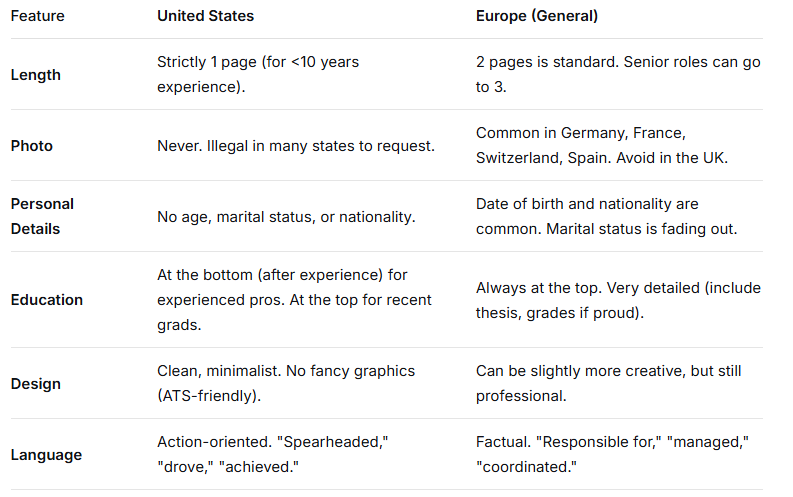
Before we get into the nitty-gritty, understand the core difference:
The US Approach: Resumes are marketing documents. Your goal is to sell yourself quickly and make the recruiter want to meet you. Brevity and impact are everything.
The European Approach: CVs (Curriculum Vitae) are biographical documents. Your goal is to provide a comprehensive overview of your professional life, education, and qualifications.
This fundamental difference drives everything else.
Side-by-Side Comparison
The US Resume: Your 60-Second Pitch
Recruiters in the US spend an average of 6-7 seconds scanning a resume. You need to grab their attention immediately.
The Formula:
Header: Name, phone, email, LinkedIn, city/state (no full address).
Professional Summary (Optional): 2-3 lines if you're changing careers or have a unique story. Otherwise, skip it.
Core Competencies/Skills: A small column or row of key skills (e.g., "Project Management | Data Analysis | Team Leadership").
Professional Experience: List jobs in reverse chronological order. For each bullet point, use the CAR method (Challenge, Action, Result). Start with a strong action verb.
Weak: "Responsible for social media."
Strong: "Grew Instagram engagement by 45% in 6 months through a targeted content strategy."
Education: Institution, degree, year. GPA only if it's impressive (3.5+).
Optional Sections: Certifications, languages, volunteer work (if relevant).
ATS Tip: The US relies heavily on Applicant Tracking Systems. Use standard fonts (Arial, Calibri), save as a .docx or .pdf as instructed, and include keywords from the job description.
The European CV: The Complete Picture
In many European countries, the CV is just the starting point for a conversation. They expect detail.
The Formula:
Header: Name, address, phone, email, date of birth, nationality. In some countries, include a professional photo in the top corner.
Education: Start here. List your degrees with dates, institutions, and specializations. Include your thesis title and any notable achievements.
Professional Experience: List in reverse chronological order. Use full sentences, not just bullet points. Describe your responsibilities thoroughly, but also include achievements.
European style: "Responsible for managing a team of five sales associates, achieving monthly sales targets, and training new staff members. Successfully increased regional sales by 15% over two years."
Skills Section:
Languages: Use the Common European Framework (A1-C2). Be honest. "Fluent" means C1/C2.
Technical Skills: List software and tools.
Interests (Optional but Common): In some countries like the Netherlands or Germany, listing hobbies (sports, volunteering, reading) can be a positive differentiator. It shows you're a well-rounded person.
References: It's common to write "References available upon request" or even list them with contact information (with their permission).
Country-Specific Nuances
Germany: Must include photo. Very formal. Include "Zeugnisse" (certificates) if requested. Use "Herr/Frau" in correspondence.
France: Photo is common. Include your "situation familiale" (marital status) is still seen but becoming optional. Handwritten cover letters are still valued in some traditional sectors.
United Kingdom: Closest to the US style. No photo, 2 pages max, focus on achievements. Target your CV to each job.
Netherlands: Very direct and concise. They appreciate honesty. Including hobbies is common and expected in interviews.
Switzerland: Multilingual country. If applying in Geneva, have a French version. If Zurich, German. Precision and detail are key.
Which One Should You Use?
Simple: Use the style of the country where the job is located.
If a US company has a European office, use the US style. If a European company has a US office, research which style their local HR prefers. When in doubt, check LinkedIn profiles of current employees in similar roles and mirror their format.
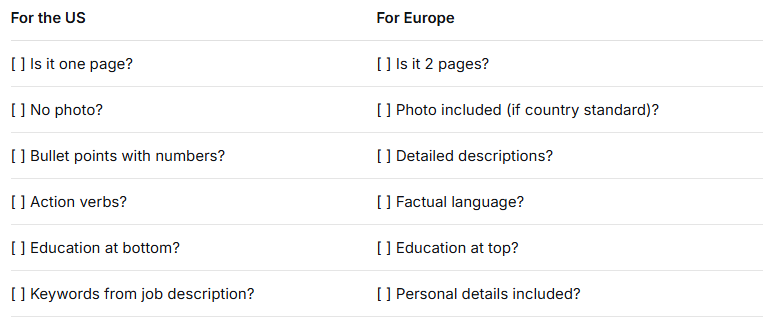
Checklist Before You Submit
The Great Resume Debate: US vs. European Styles Explained
The Bottom Line
Your resume is not a static document. It's a tool that should adapt to its audience. By understanding these transatlantic differences, you're not just submitting a piece of paper – you're showing employers that you've done your homework and understand their culture. And that alone can set you apart.
What's the most confusing resume rule you've encountered? Let us know in the comments!
Menu
Support
© 2025. All rights reserved.